Pushing the boundaries of military training
simulation at the world’s largest MS&T conference

Pushing the boundaries of military training simulation at the world’s largest MS&T conference

Strategic alignment

Storyboarding

0-1 UX/Product design

User interface

Stakeholder management

7 minute read
Role:
Lead Product Designer shaping the demo vision and delivery

Team:
18 including Engineering, Data Science, QA, Product and 9 partners

Timeline:
12-week delivery incl discovery, testing, rehearsals and live demos

context

I led design for a live demo at I/ITSEC 2022, translating a simulation expert's vision into an executable plan for a 15-person internal team and 9 external partners. We had 12 weeks to prove our approach for the UK MOD's £1.2B programme.

Why this matters

Large-scale collective training traditionally requires deploying thousands of troops and vehicles to training grounds. Synthetic environments complement live training, at any scale, enabling forces to train more frequently at lower cost, explore scenarios too dangerous or complex for physical exercises, and refine tactics before expensive live deployments. That's why the MOD is investing in this capability.


The opportunity

I/ITSEC is the world's largest event for modeling, simulation, and training (MS&T), attracting over 18,000 attendees from 55+ countries annually. The UK MOD was offering a £1.2B contract over 15 years to transform military training for 60,000 soldiers using AI, VR, and cloud-based simulations.


The competition

Seven major defense consortia were competing for the UK MOD's Collective Training Transformation Programme (CTTP). Improbable Defence was part of Omnia Training (Raytheon UK-led) as the "strategic synthetic integrator."

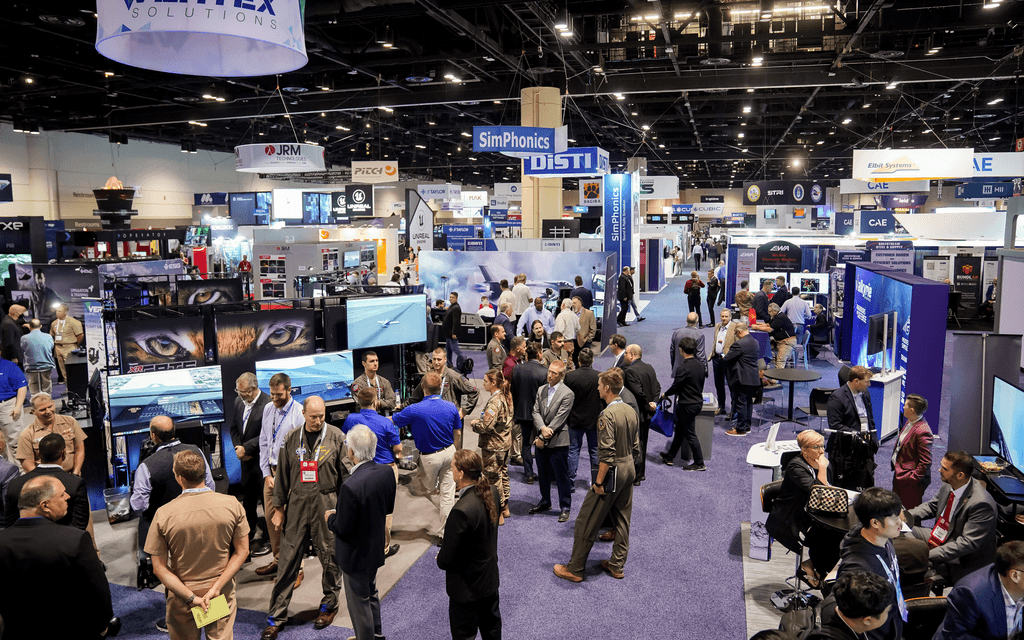
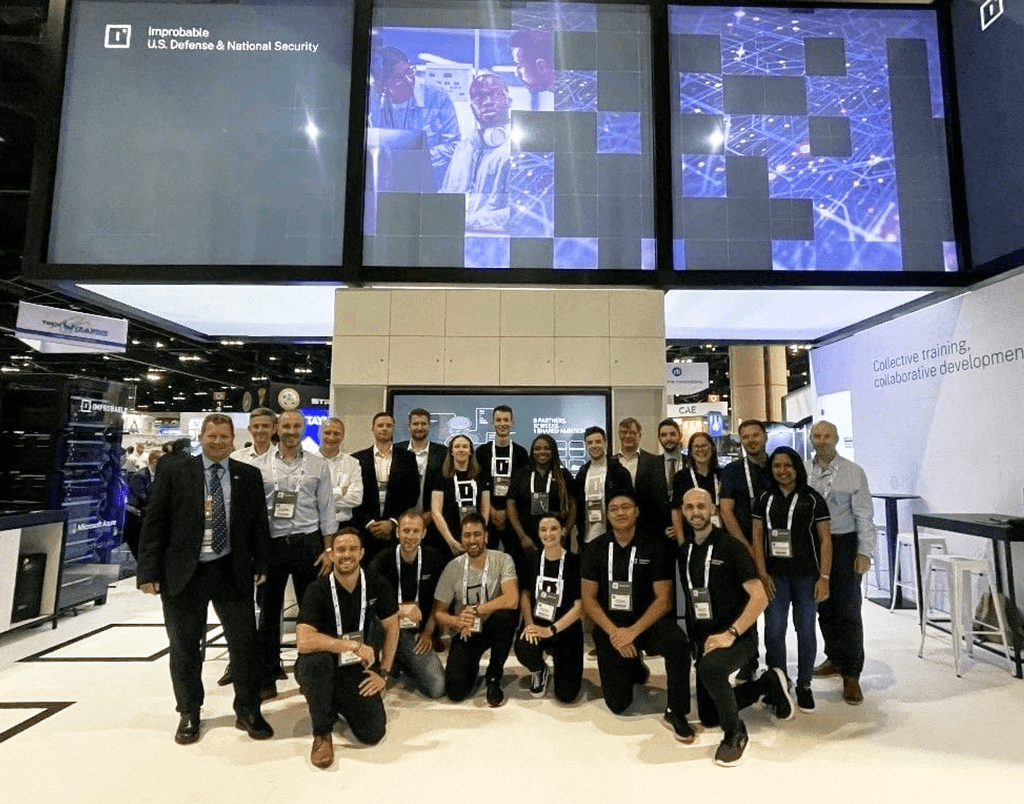
Exhibition hall at I/ITSEC, Orange County Convention Center, Florida

The challenge

Lead the design for a live demo proving our consortium could deliver seamless multi-partner integration across virtual, constructive, and live (LVC) training systems.

Our simulation expert's ambitious vision was trapped in a complex spreadsheet that everyone interpreted differently. Engineers, partners, military SMEs, and the product team all saw different things when they looked at the plan. I needed to do the following:

  • Create shared understanding across fifteen people from different disciplines and nine organisation

  • Ensure military SMEs validated the scenario's realism

  • Deliver a flawless live demonstration that would differentiate us from six competitors

  • Do all of this in 12 weeks

  • Do all of this in 12 weeks

  • Design an interface that unified sentiment feeds, geospatial overlays, and analysis tools into a coherent experience
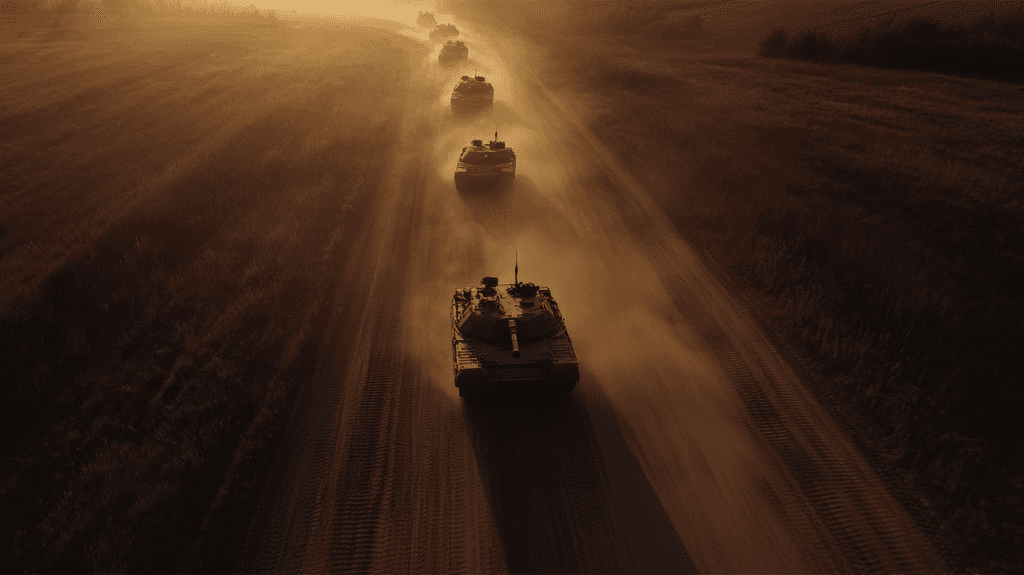
A glimpse of what’s possible when industry, academia, and defence unite to build synthetic environments that evolve as fast as emerging threats.

A glimpse of what’s possible when industry, academia, and defence unite to build synthetic environments that evolve as fast as emerging threats.

Approach

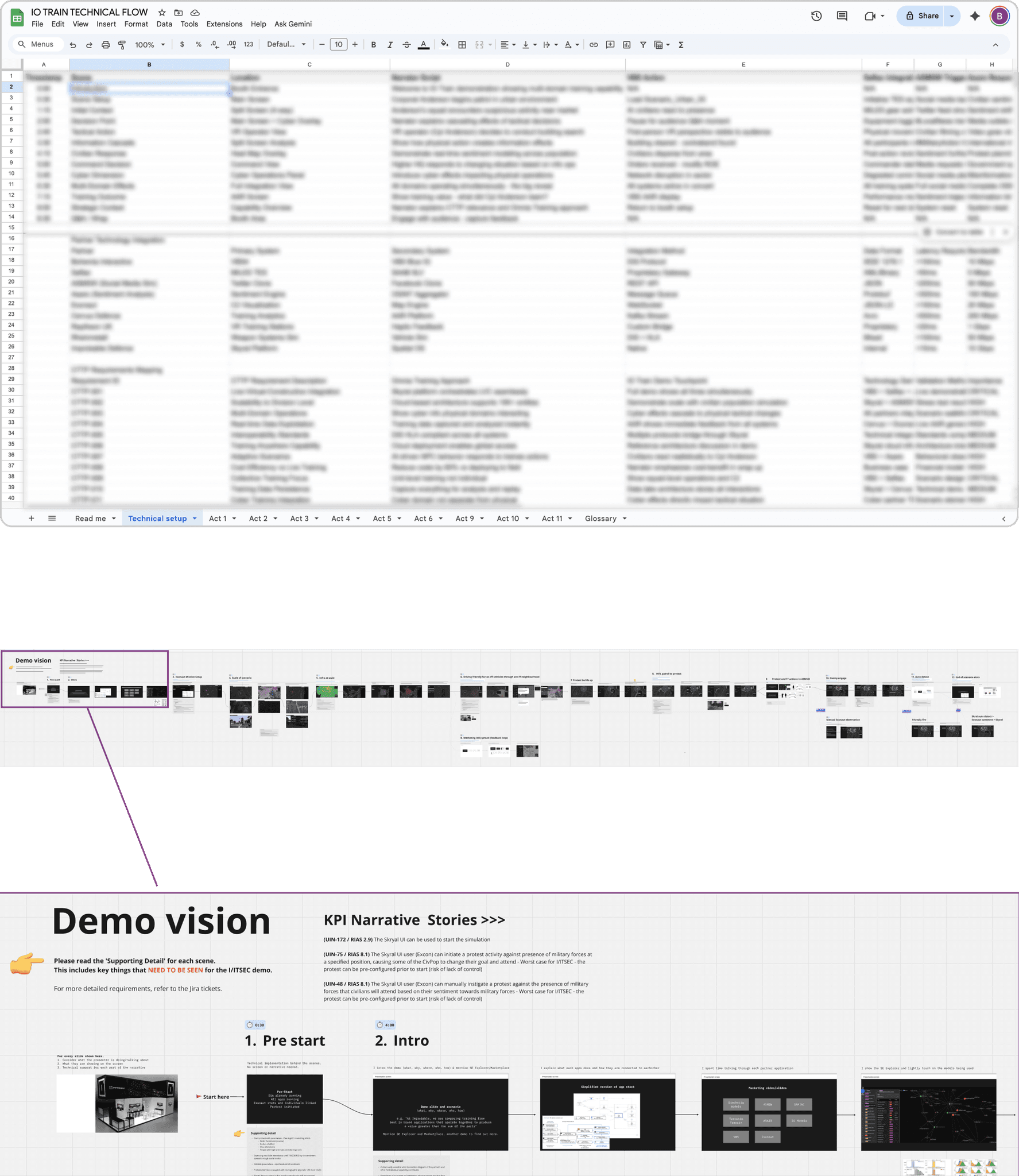
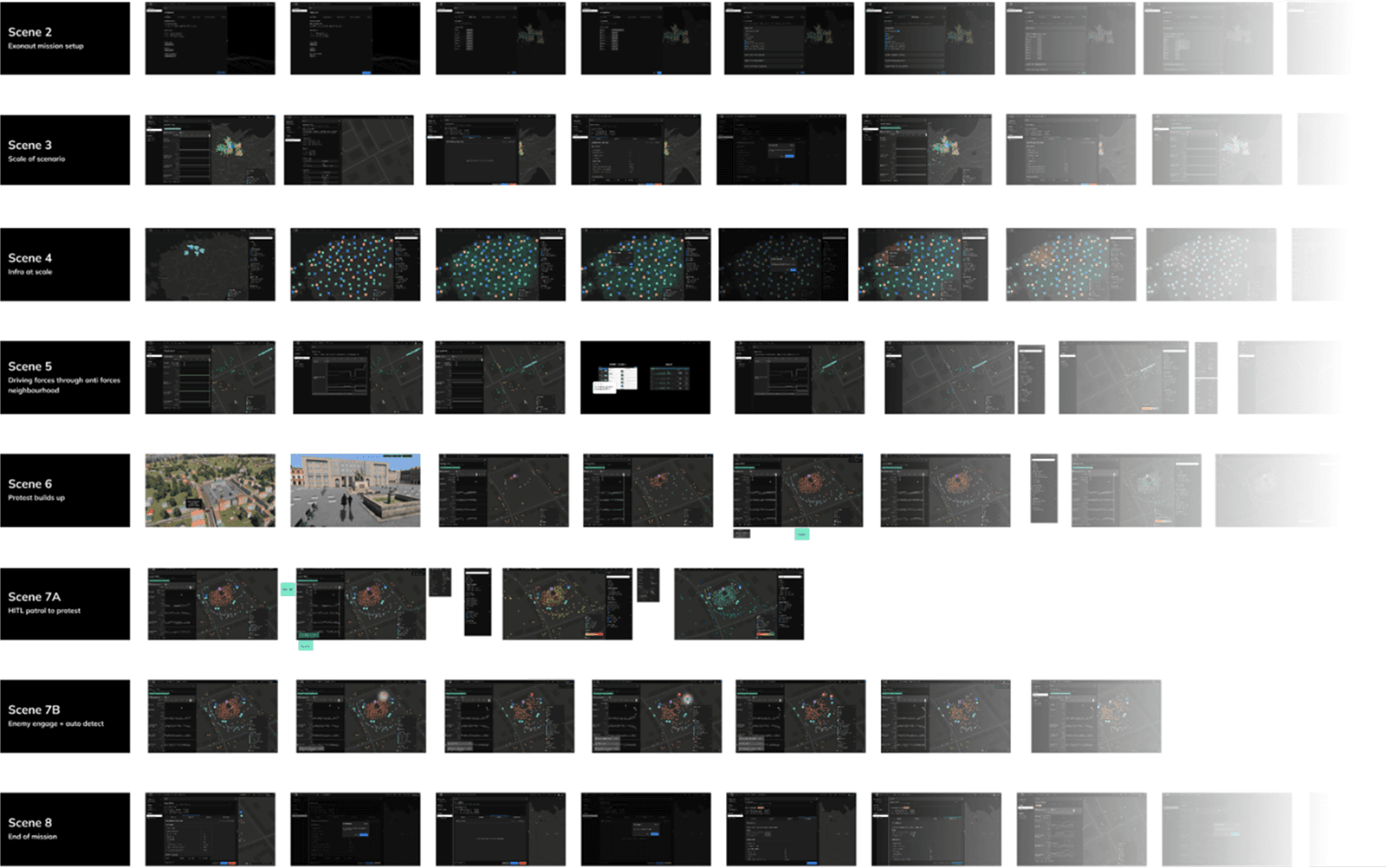
I spent the first two weeks working intensively with our simulation expert, translating his complex spreadsheet into a visual storyboard that showed the demo from the audience's perspective, frame by frame, moment by moment.


The storyboard became both a blueprint for engineers and a contingency plan in case the live demo wasn't ready for the conference.

What the storyboard showed:

  • Frame-by-frame screen content (four screens at times) by timestamp

  • What the narrator would say at each moment

  • Which technical capabilities we were demonstrating

  • Which partner technologies were showcased

  • Where the "wow moments" would hit

The results, the 'glue':

  • Engineers could see what to build

  • Partners could see how they'd be featured

  • Military SMEs could validate realism

  • Product team could see value propositions

  • Everyone finally saw the same thing

Top: The complex Google sheet. Bottom: Storyboard in Miro

The story that brought it together

Built as both a blueprint for engineers and a contingency plan in case the live demo wasn’t ready for the conference. We created an eight act narrative that demonstrated technical capabilities through a realistic military scenario:
ACT 1: Setting the Scene

Explain the platform, interoperability with our key partners and introduce our protagonist Corporal Anderson


ACT 2: Mission begins

Training begins, objectives loaded, every action tracked and analysed live


ACT 3: Scale of simulation

Camera sweeps and we see 250,000 entities, each with its own pattern of life in motion, across VBS, SAF-TAC and Skyral


ACT 4: Infrastructure modelling

Power fails, networks drop, connections fracture, information flow collapses, see downstream impact

ACT 1: Setting the Scene
Explain the platform, interoperability with our key partners and introduce our protagonist Corporal Anderson


ACT 2: Mission begins
Training begins, objectives loaded, every action tracked and analysed live


ACT 3: Scale of simulation
Camera sweeps and we see 250,000 entities, each with its own pattern of life in motion, across VBS, SAF-TAC and Skyral.


ACT 4: Infrastructure modelling
Power fails, networks drop, connections fracture, information flow collapses, see downstream impact

ACT 5: NATO convoy enters a hostile district.

Patrol drives through a neighbourhood already hostile to friendly forces. Tension brews on every street


ACT 6: Sentiment shifts, fear spreads, protests ignite.

Online anger rises, social networks ripple with fear and misinformation. Crowds gather fast, troops encircle, weapons raised, pressure mounting by the second


ACT 7: Escalation point

As the protest intensifies, Anderson cocks his weapon, panic spreads, a shot is fired, and the crowd breaks


ACT 8: After-action review

Moments rewind, data reveals why it escalated, what we can learn

ACT 5: NATO convoy enters a hostile district
Patrol drives through a neighbourhood already hostile to friendly forces. Tension brews on every street


ACT 6: Sentiment shifts, fear spreads, protests ignite
Online anger rises, social networks ripple with fear and misinformation. Crowds gather fast, troops encircle, weapons raised, pressure mounting by the second


ACT 7: Escalation point
As the protest intensifies, Anderson cocks his weapon, panic spreads, a shot is fired, and the crowd breaks


ACT 8: After-action review
Moments rewind, data reveals why it escalated, what we can learn

High fidelity storyboard in Figma

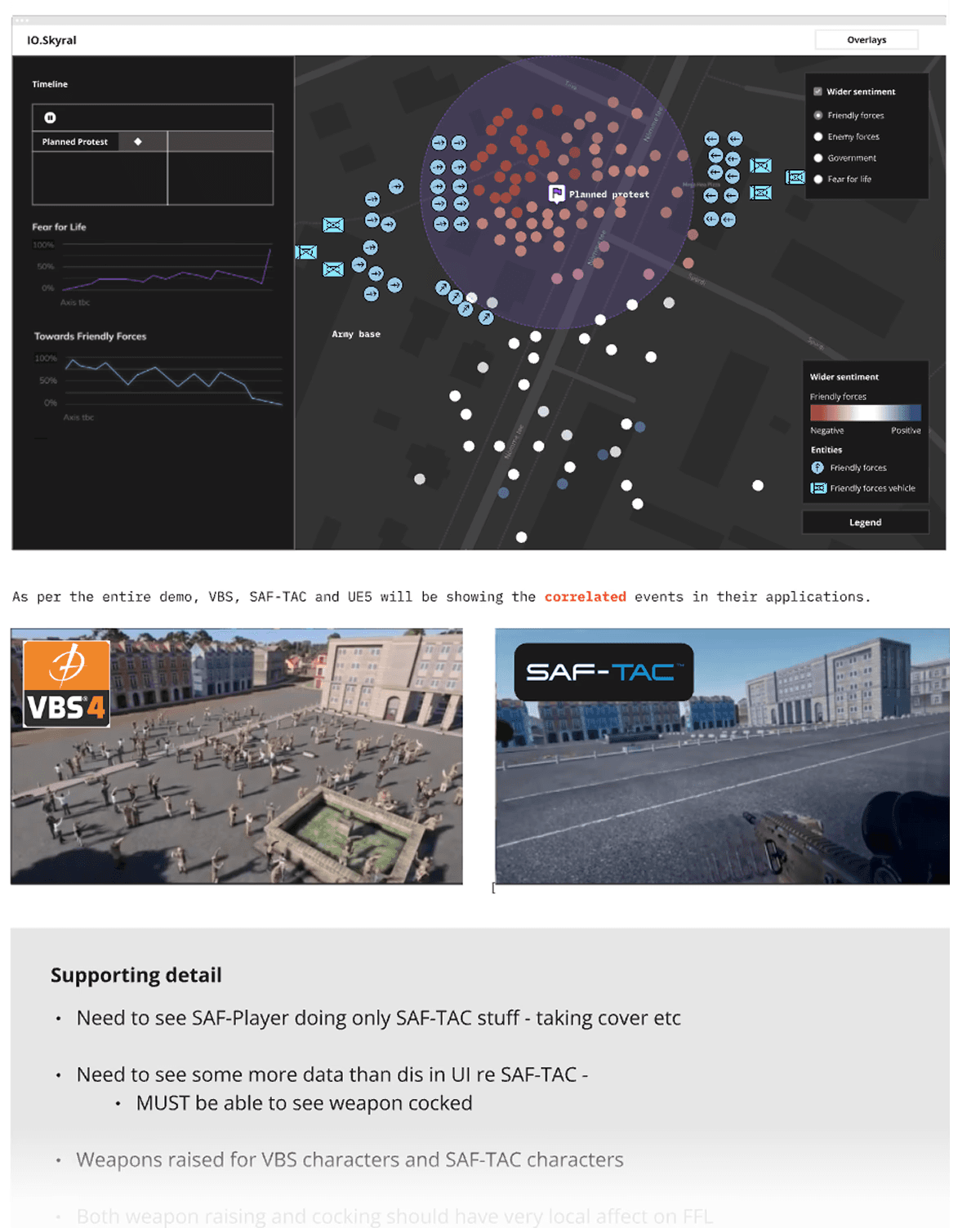
Storyboard showing low fidelity Skyral screen, VBS and SAF-TAC

Design

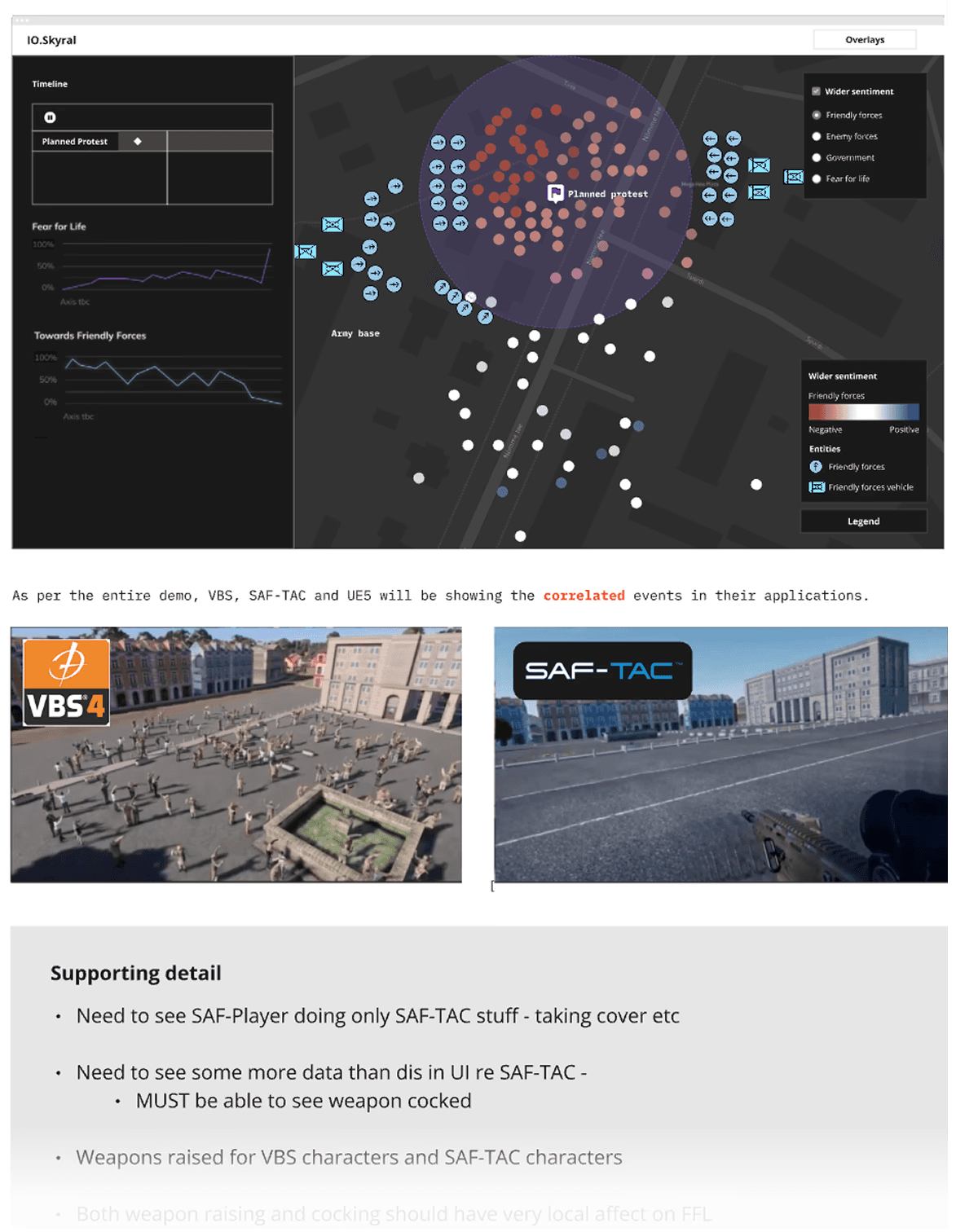
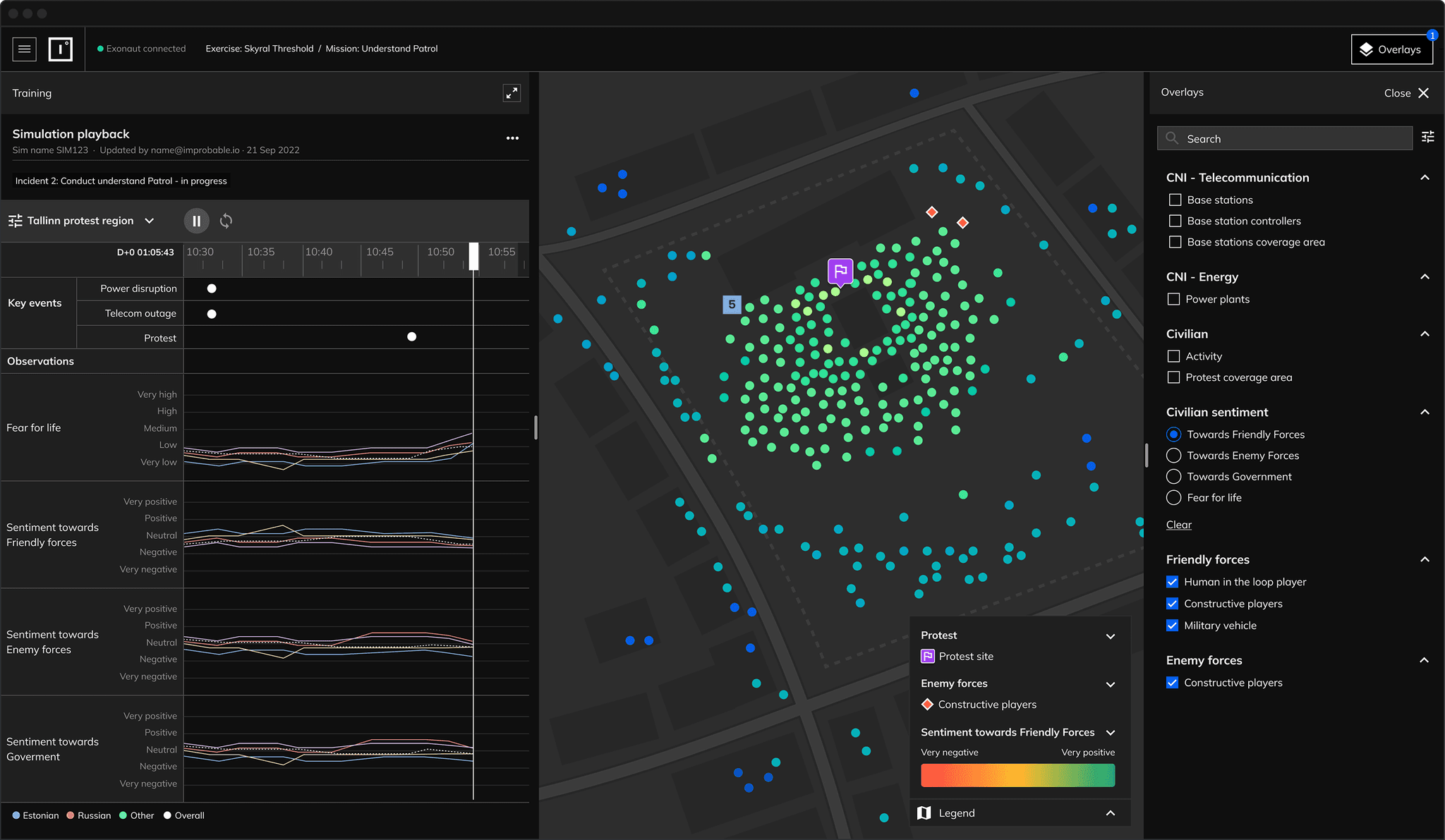
I designed an interface that brought simplicity to complex multi-domain data, connecting sentiment feeds, geospatial overlays, and analysis tools within a single visual framework.

Key interface features:

  • Top ribbon: Navigation, system status

  • Live simulation playback: Switch between geographic regions, timeline visualising key events and sentiment trends over time, key sentiment by nationality

  • Map view: Dots represent human, live, and constructive players; legend explaining sentiment, actors and overlays; layers for CNI, forces, civilians and sentiment by group

  • The interface had to handle 250,000+ entities while remaining readable and supporting the narrative, showing overwhelming complexity when needed, but simplifying to clarity for decision-critical moments.
Rehearsing the demo

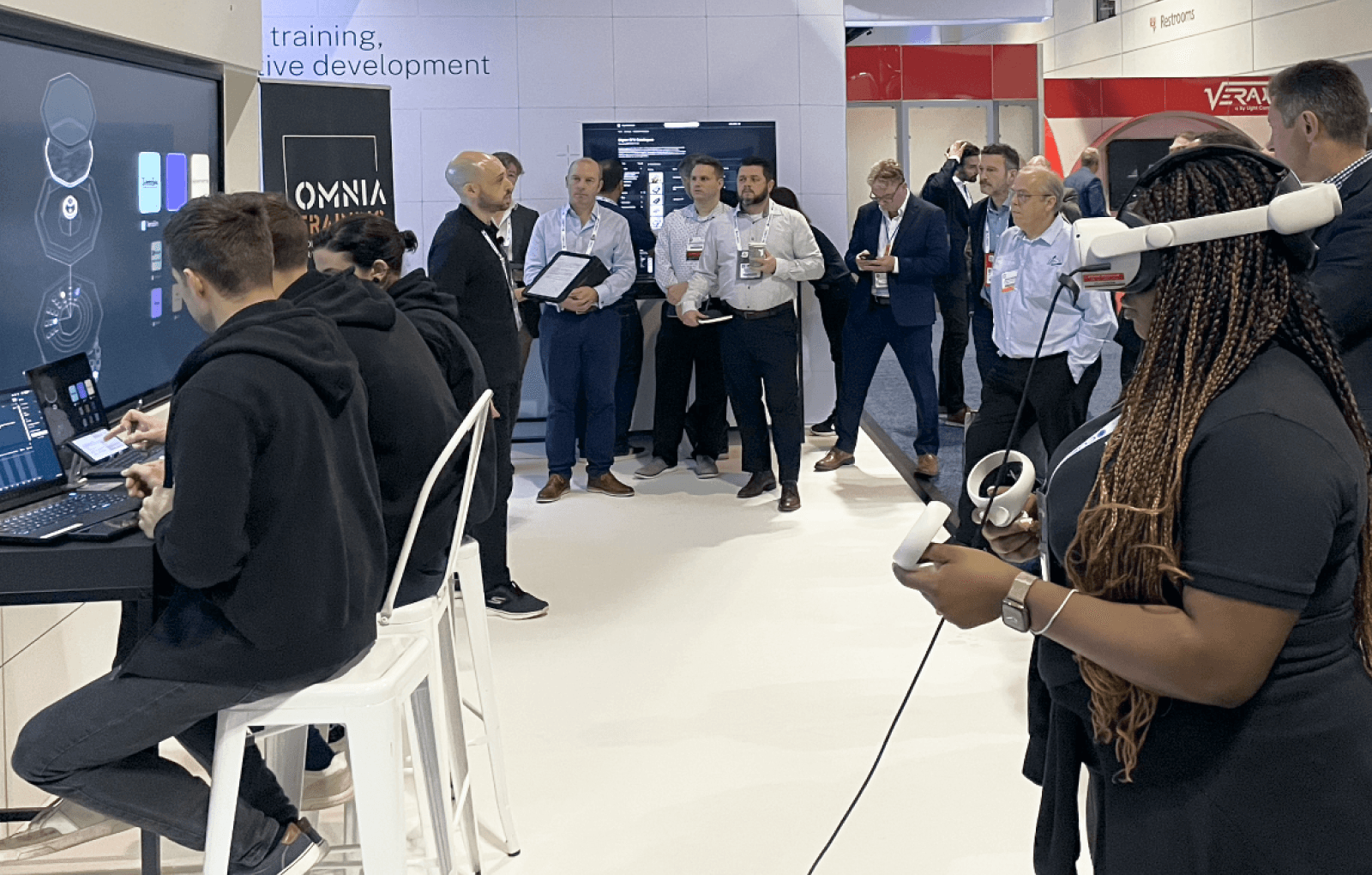
The team rehearsed daily for weeks, fine-tuning system links, visuals, and timing to deliver a polished, reliable live demonstration.

We structured rehearsals like theatre:

  • Full run-through every morning with no stopping (built resilience for live conditions)

  • Debrief to prioritise issues (demo-killers first, then narrative problems, then polish)

  • Validation runs of corrected sections

  • The "no stopping" rule was critical, it forced us to develop workarounds and built muscle memory for handling problems gracefully during live demos
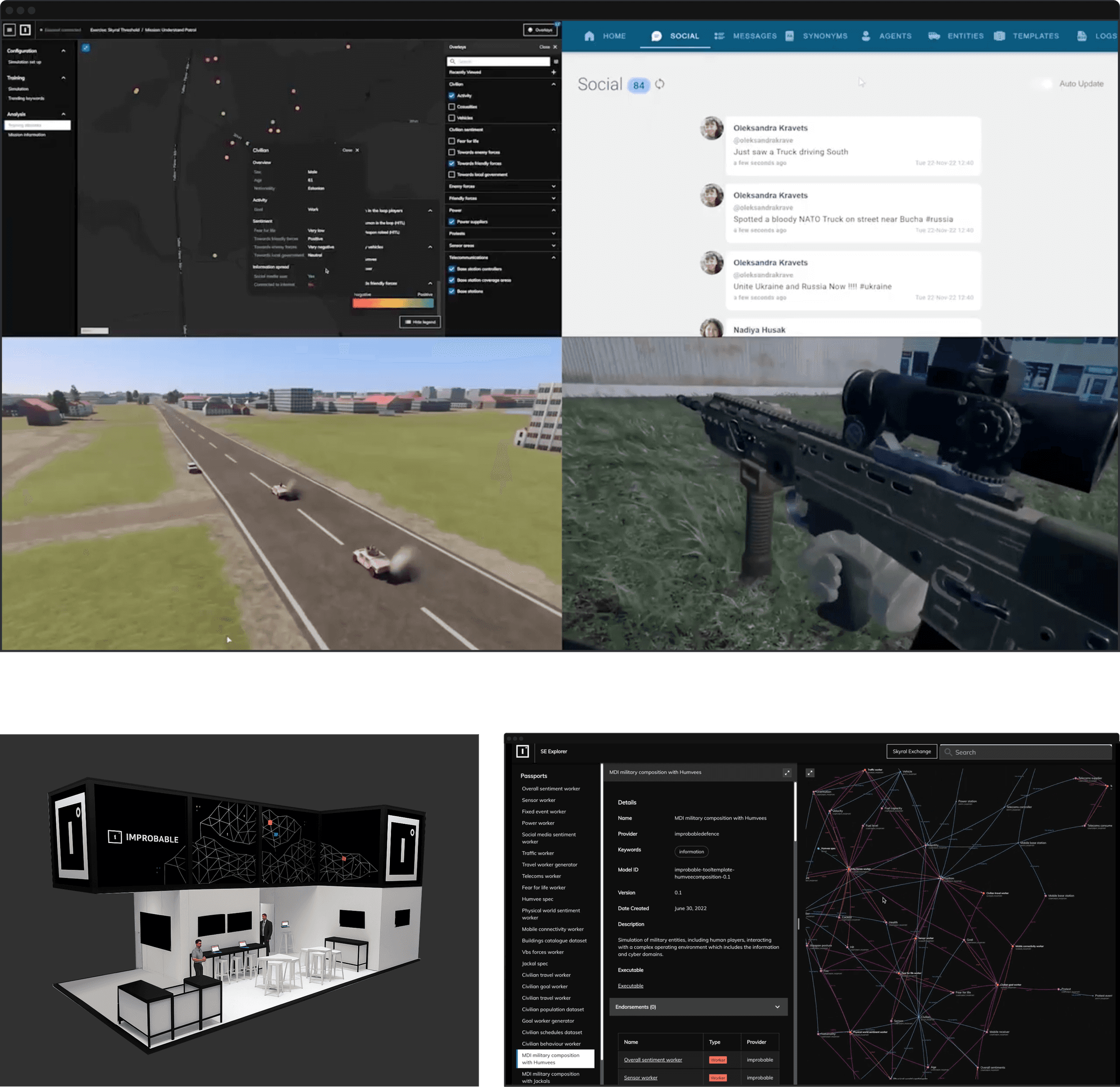
Top: Demo split view showing Skyral, Social media feed, VBS and SAF-TAC. Bottom left: CGI of exhibition design. Bottom right: Syntethic Explorer, market place to data models.

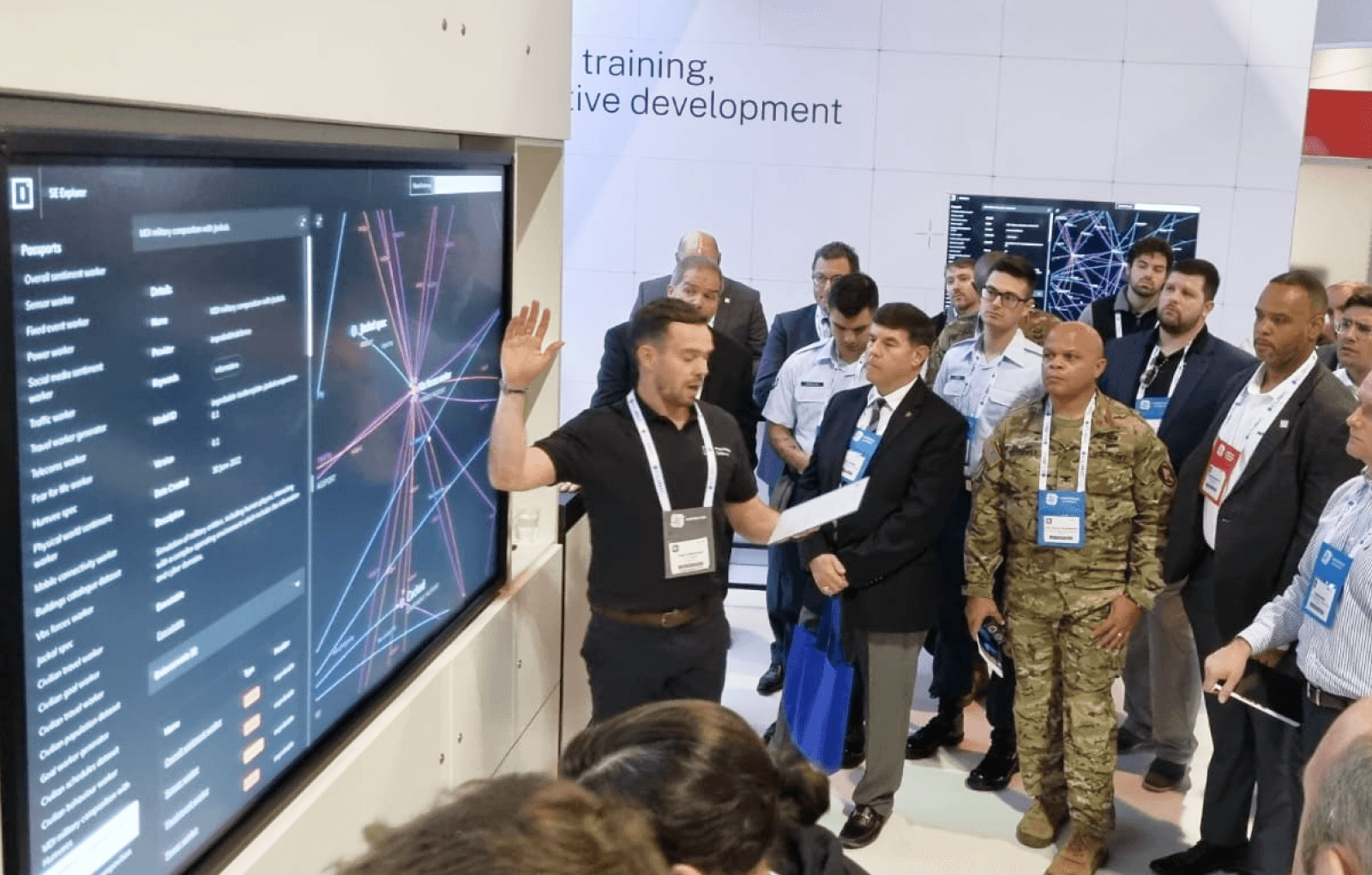
Live demos set us apart from competitors' recorded videos
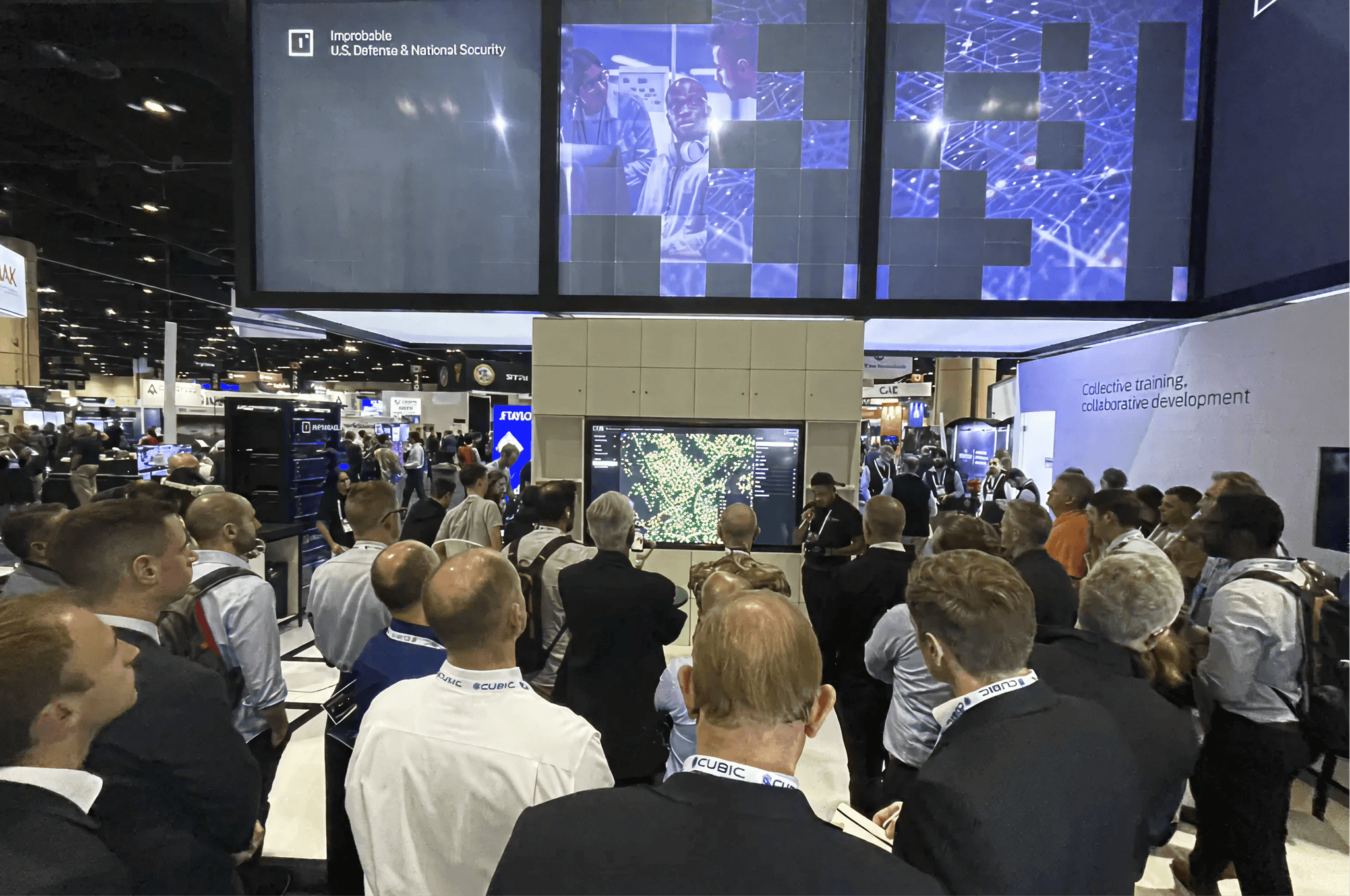
We delivered more than fifteen fully successful live demos across four days, with zero critical failures, despite the technical complexity. These sessions engaged UK MOD, US DOD, NATO stakeholders, and strengthened nine partner relationships.

What we proved:

  • Differentiation: Showed real, working technology while competitors relied on recorded or conceptual presentations.

  • Credibility: Proved multi-partner interoperability at scale and validated our consortium’s technical approach.

  • Positioning: Reinforced Improbable Defence as a credible strategic synthetic integrator.

  • Opportunity: Sparked follow-on conversations with US DOD and generated multiple leads beyond CTTP.


How we stood out

We prioritised showing live interoperability across multiple partners and operating within a large-scale simulation environment. This approach carried more technical risk but demonstrated real capability in context. By presenting working technology rather than static or pre-recorded material, our consortium differentiated itself from other teams in the competition.


What it led to

Military evaluators confirmed scenario realism and were most impressed by interoperability. The demos strengthened partner confidence, advanced relationships with UK MOD and US DOD, and opened new business avenues beyond the original scope.


We delivered more than fifteen fully successful live demos across four days, with zero critical failures, despite the technical complexity. These sessions engaged UK MOD, US DOD, NATO stakeholders, and strengthened nine partner relationships.

What we proved:

  • Differentiation: Showed real, working technology while competitors relied on recorded or conceptual presentations.

  • Credibility: Proved multi-partner interoperability at scale and validated our consortium’s technical approach.

  • Positioning: Reinforced Improbable Defence as a credible strategic synthetic integrator.

  • Opportunity: Sparked follow-on conversations with US DOD and generated multiple leads beyond CTTP.


How we stood out

We prioritised showing live interoperability across multiple partners and operating within a large-scale simulation environment. This approach carried more technical risk but demonstrated real capability in context. By presenting working technology rather than static or pre-recorded material, our consortium differentiated itself from other teams in the competition.


What it led to

Military evaluators confirmed scenario realism and were most impressed by interoperability. The demos strengthened partner confidence, advanced relationships with UK MOD and US DOD, and opened new business avenues beyond the original scope.

We delivered more than fifteen fully successful live demos across four days, with zero critical failures, despite the technical complexity. These sessions engaged UK MOD, US DOD, NATO stakeholders, and strengthened nine partner relationships.

What we proved:

  • Differentiation: Showed real, working technology while competitors relied on recorded or conceptual presentations.

  • Credibility: Proved multi-partner interoperability at scale and validated our consortium’s technical approach.

  • Positioning: Reinforced Improbable Defence as a credible strategic synthetic integrator.

  • Opportunity: Sparked follow-on conversations with US DOD and generated multiple leads beyond CTTP.


How we stood out

We prioritised showing live interoperability across multiple partners and operating within a large-scale simulation environment. This approach carried more technical risk but demonstrated real capability in context. By presenting working technology rather than static or pre-recorded material, our consortium differentiated itself from other teams in the competition.


What it led to

Military evaluators confirmed scenario realism and were most impressed by interoperability. The demos strengthened partner confidence, advanced relationships with UK MOD and US DOD, and opened new business avenues beyond the original scope.

Reflections and learnings

12 weeks to deliver the imposible. How investing in clarity and shared vision accelerated everything else

Speed requires focus, not shortcuts

The two-week storyboard phase paid dividends throughout the remaining ten.Low-fidelity design enabled rapid alignment and iteration where high fidelity would have slowed us down.


Clarity matters more than polish

In high-stakes environments, progress depends on shared understanding more than pixel-perfect outputs. Visualising the end state early helped every team pull in the same direction.


Design leadership is facilitation

Leading design extends beyond craft to enabling collaboration across organizational boundaries.

Speed requires focus, not shortcuts

The two-week storyboard phase paid dividends throughout the remaining ten.Low-fidelity design enabled rapid alignment and iteration where high fidelity would have slowed us down.


Clarity matters more than polish

In high-stakes environments, progress depends on shared understanding more than pixel-perfect outputs. Visualising the end state early helped every team pull in the same direction.


Design leadership is facilitation

Leading design extends beyond craft to enabling collaboration across organizational boundaries


Live event research is different

Conference research requires different skills: rapid screening, finding quiet spaces, real-time synthesis amid chaos.


Resourcefulness under pressure

Tight timelines and shifting priorities required adaptability over process.Staying flexible kept momentum when conditions changed daily.


Domain knowledge is essential

Understanding CTTP requirements, multi-domain operations, and LVC training wasn't optional, it enabled better design decisions and credible stakeholder conversations.

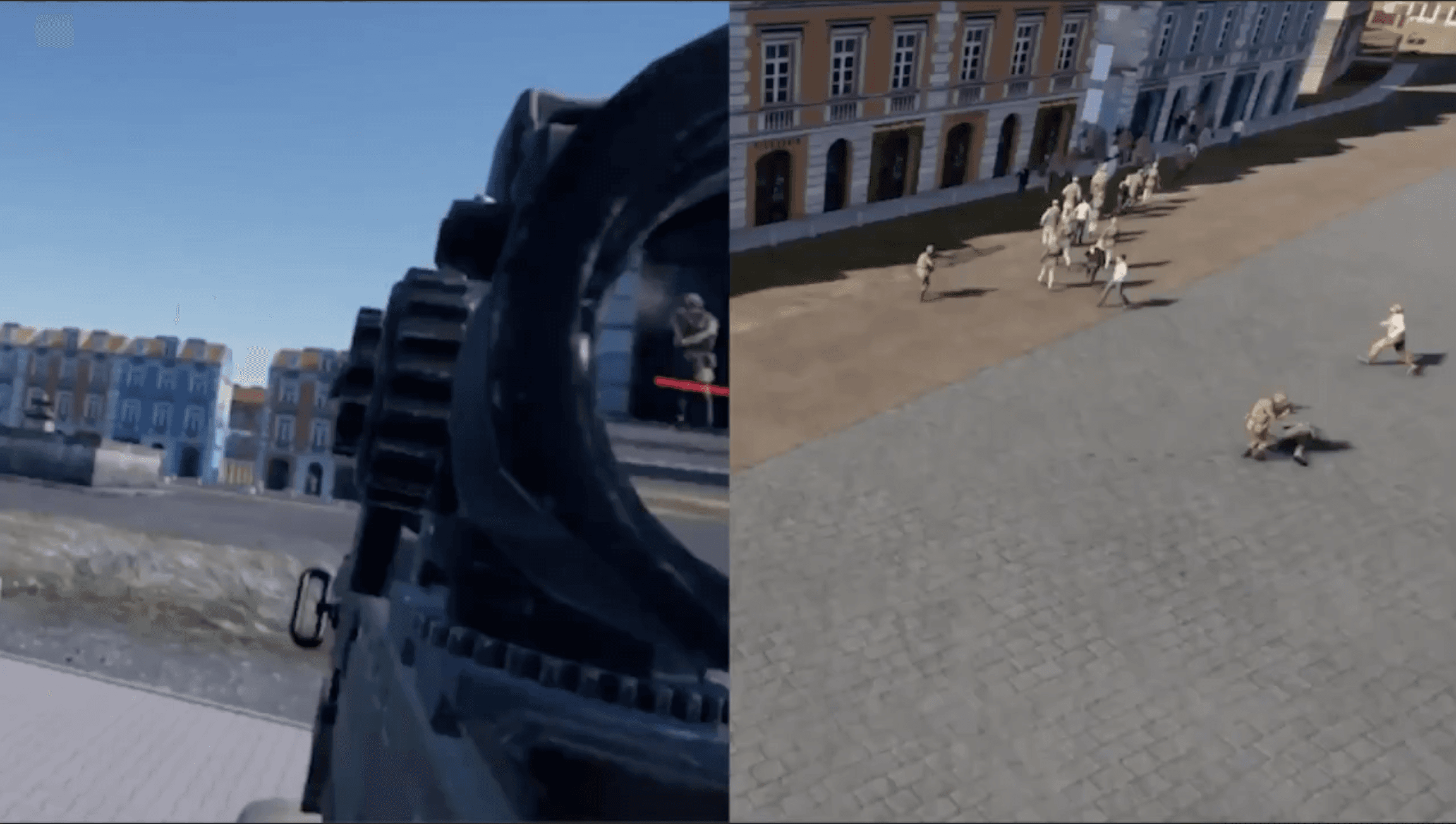
Click the video below to see the demo in action
Other projects

Other projects

Other projects

Military planning

Transforming capability from proof of concept to mission-ready

Transforming capability from proof of concept to mission-ready

Transforming capability from proof of concept to mission-ready

selling app

Created an app to empower customers to put their home on the market

Created an app to empower customers to put their home on the market

Created an app to empower customers to put their home on the market